
An original boat concept in 3D: one master model, night renders and the electrics X-rayed
I built an 11.8 m electric sport boat concept as my own practice project. Here is the whole chain: one versioned master model, night renders, short technology clips and X-ray views of the electrical system. And what a company can take from it for its own product.
Short answer
OMA118 Sport is my own 11.8 m electric sport boat concept, built as one versioned master model. The same model produced the night renders, four short technology clips and X-ray views of the electrical system. The boat is not for sale and its seaworthiness has not been demonstrated. The method is the useful part: once a product has one proper model, its marketing material can exist before the first unit does.
Key takeaways
- One master model that is never rewritten. Every version builds on the previous one and the old one stays there to be checked.
- Show technology one function at a time. A five-second clip of a hull light switching on explains more than a paragraph.
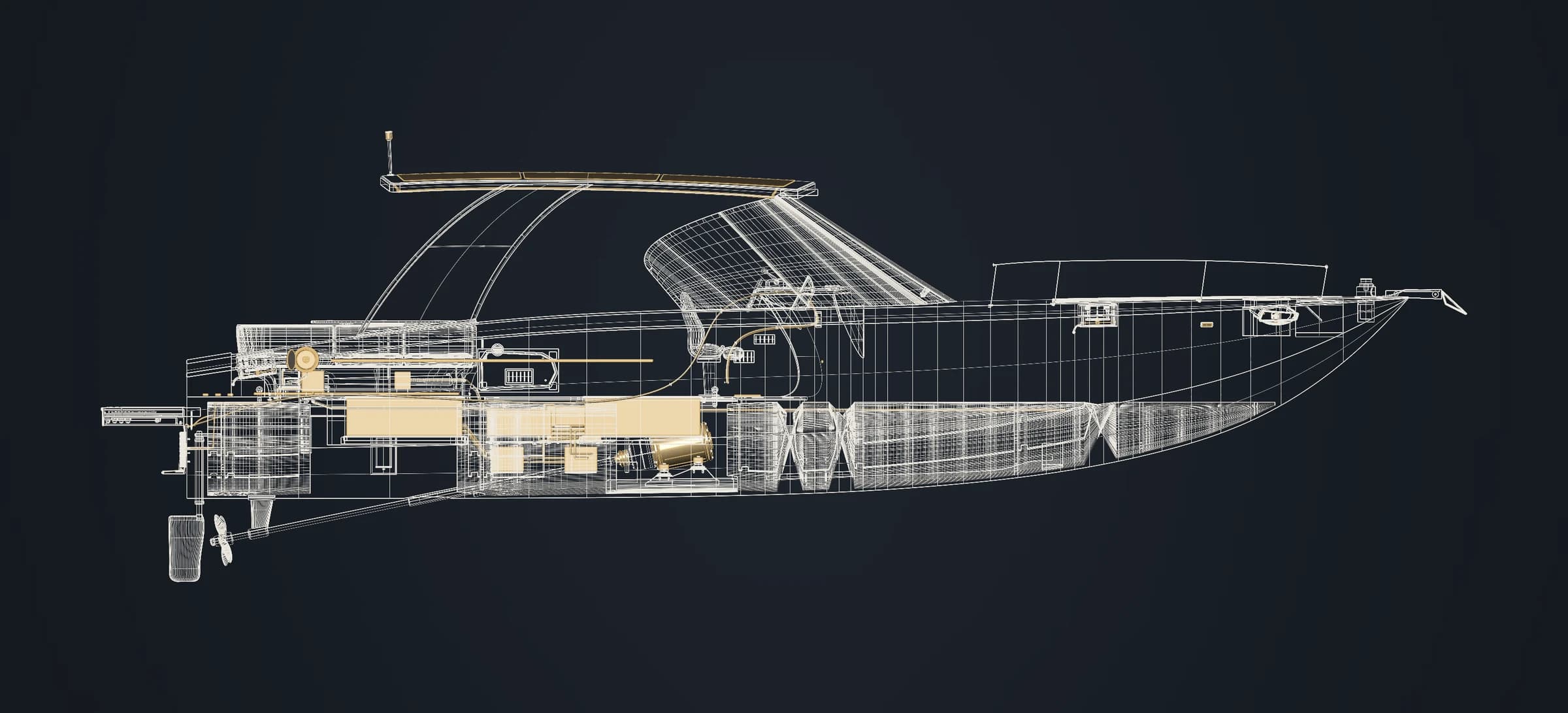
- An X-ray view with a wireframe hull and the electrics in gold shows where the batteries, motor and routes sit, without anyone reading a diagram.
- Honesty is part of the sales pitch. The dimensions are targets, no hardware has been selected, and that is said next to the picture.
Why I built a boat that does not exist
A client sees the end result: a render, a clip or a configurator. Few see what sits underneath. I wanted one project where the whole chain is in my own hands from start to finish, with no client deadline and no product secrets to hide.
A boat was the natural choice. It has form, glass, upholstery, mechanics and electrics in one package, and each of them has to be presented differently. A hull light is shown by switching it on. A battery bank is shown sitting inside the hull. A hull line is shown at night on the water.
The boat is a concept. It is not for sale, its seaworthiness has not been calculated, and not a single real component has been selected for it. Every picture and clip in this article comes from the same model.
Three directions, one chosen
First I drew three directions: a closed coupé, a sport hardtop and an open centre console. Sport won because the hull, glass, roof and upholstery read as clearly separate parts. Those are exactly the parts a buyer wants to change, and exactly the parts worth keeping separate in the model.
The target dimensions were locked straight away: 11,800 millimetres long, 3,550 wide. Propulsion is an electric inboard with a shaft drive and no visible outboard. The design target is 20 knots and 30 nautical miles with a fifth of the battery left. That is a target, not demonstrated performance, and the difference is stated everywhere the number appears.
Locking the dimensions early sounds like a small thing. It still decides how big a table fits between the aft seats and how many solar panels go on the roof.
One master model, every change as its own version
The whole boat lives in one native CAD master model. Every change is made as its own version on top of the previous one, so the old geometry stays unchanged. If something turns out to be wrong, you go back and look at what changed. Versions pile up, and that is the point: a small version is cheap to check and a big one is expensive to fix.
Before a version is accepted it goes through the same gates: fit and clearance checks, round-trip tests into another file format and back, and object-count comparisons. Boring work. It is also what separates a model you can make pictures from and a model you can make the next version from.
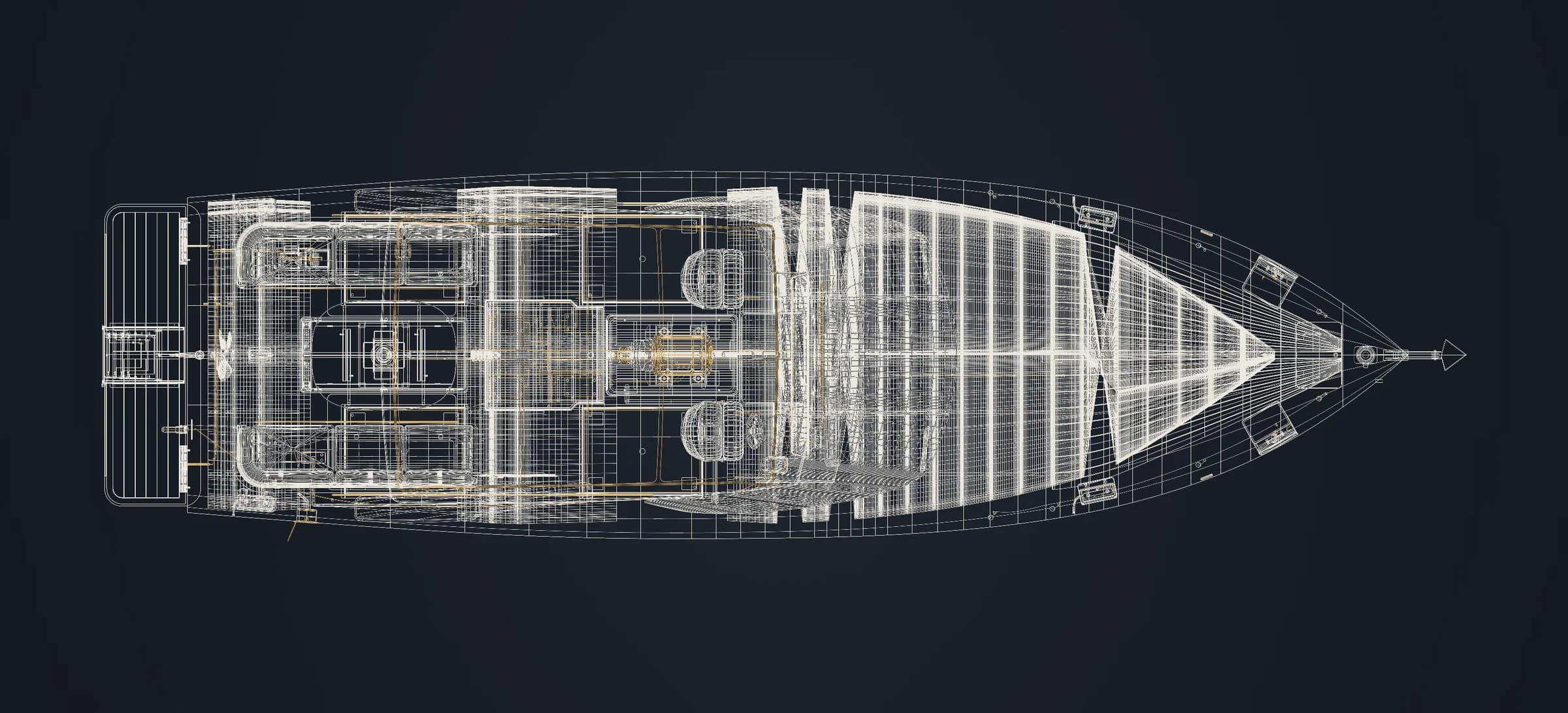
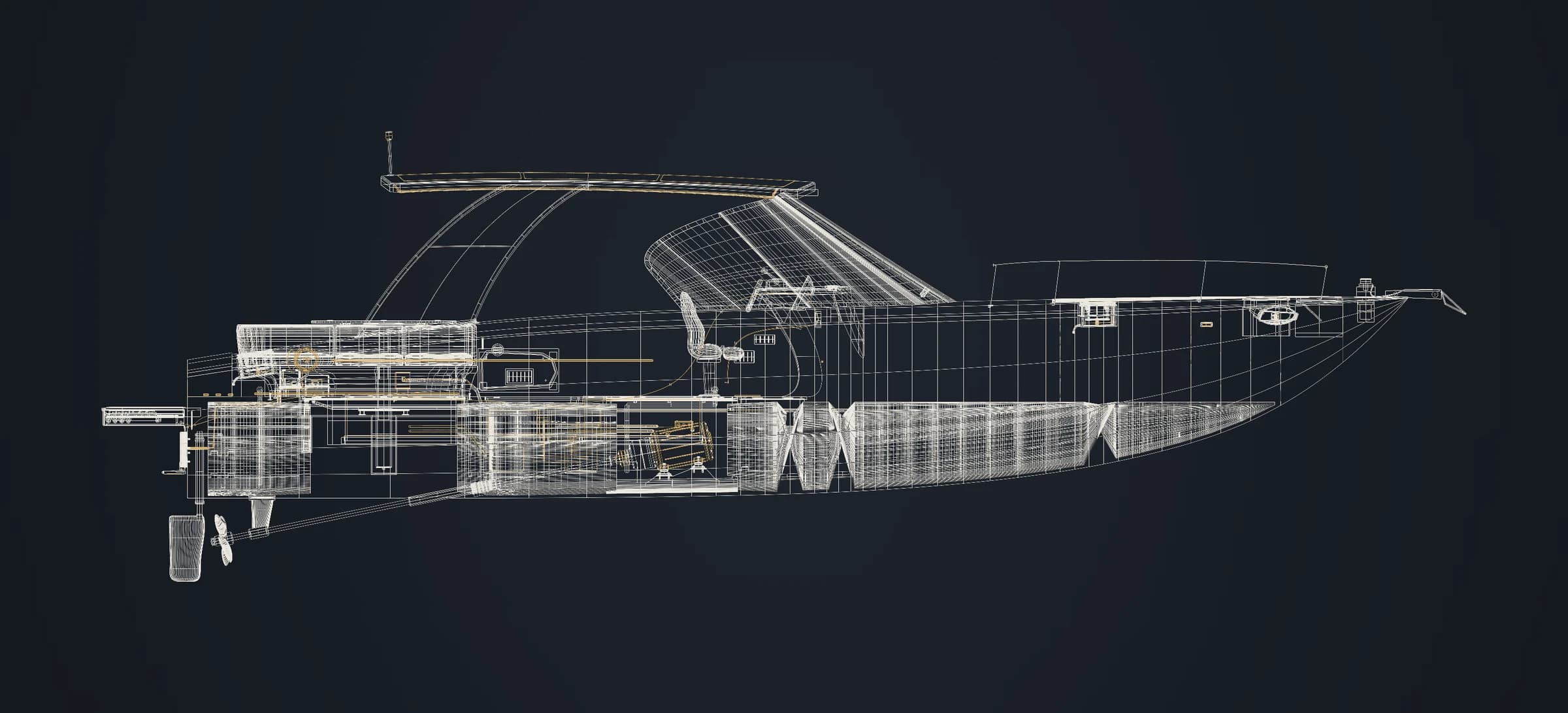
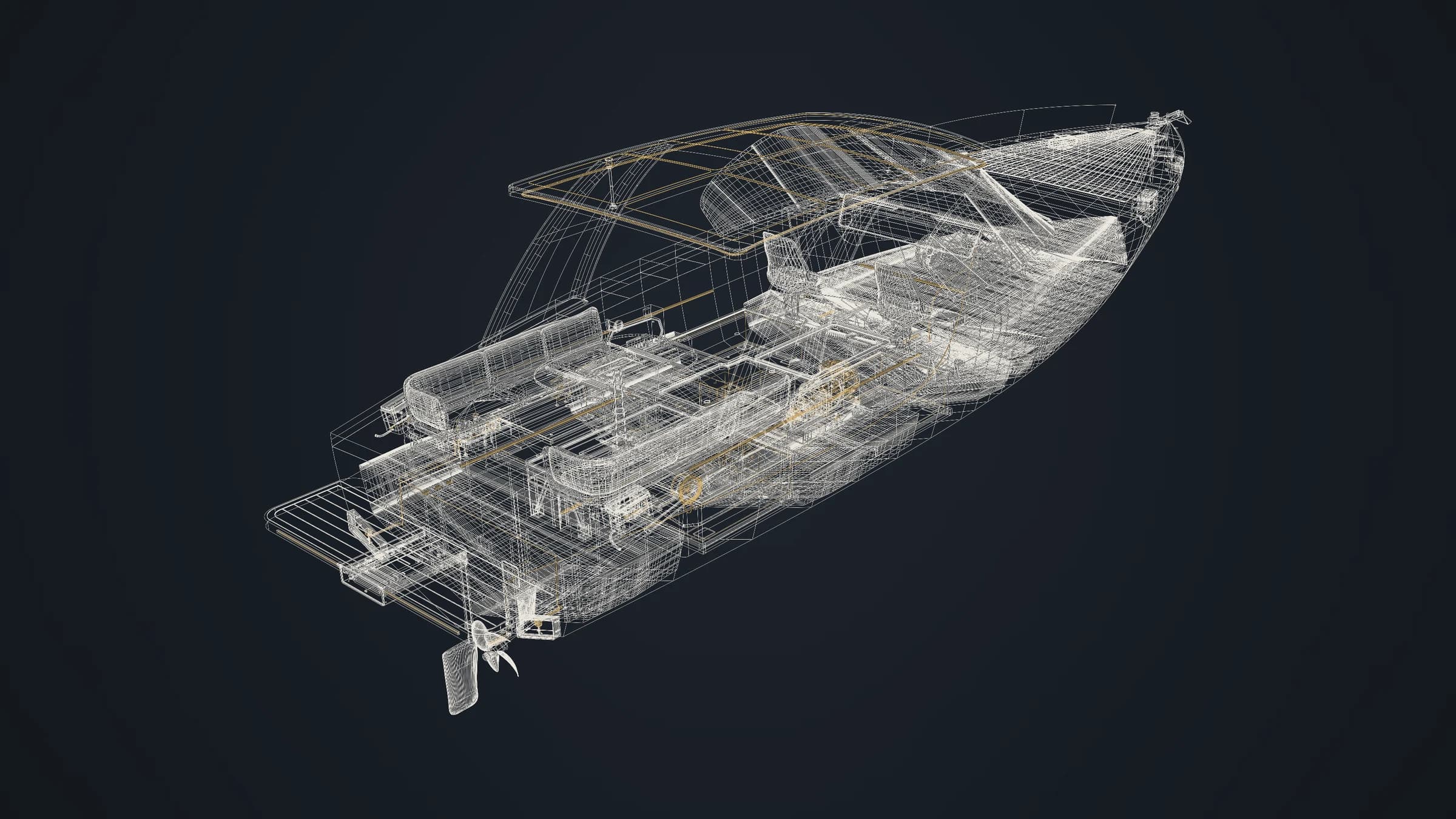
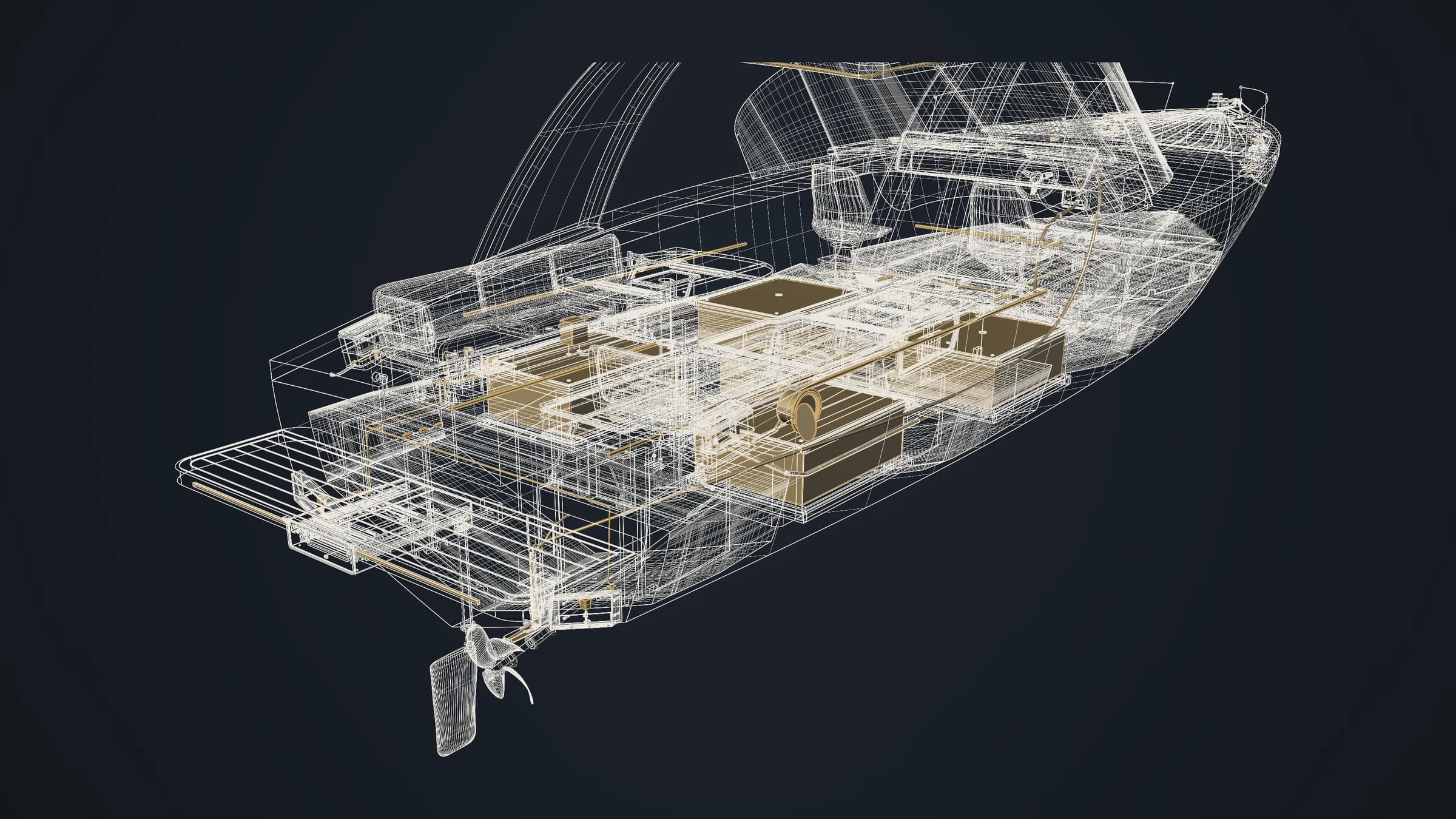
The wireframes below come straight from the master model. They are not dimensioned drawings and nothing can be measured from them. They show what a render hides: every surface, seam and route. From above you notice how much structure sits under the seats, the table and the hatches.
Technology is shown one function at a time
In a product presentation there is a temptation to show everything at once. On a phone that does not work. I made four short clips, each with one thing happening: the helm display wakes up, the hull light switches on, a cleat rises out of the deck and the charge hatch opens.
The clips are five to eight second renders from the same master model. They start with the movement, not with a still, and they loop without sound. On the website they only load once they come into view, so the page does not slow down because of them.
The logic is the same as in client work. A buyer sees a social post, gets interested, and then needs a calm place where the details can be looked at without arrows and captions.
The electrics, X-rayed
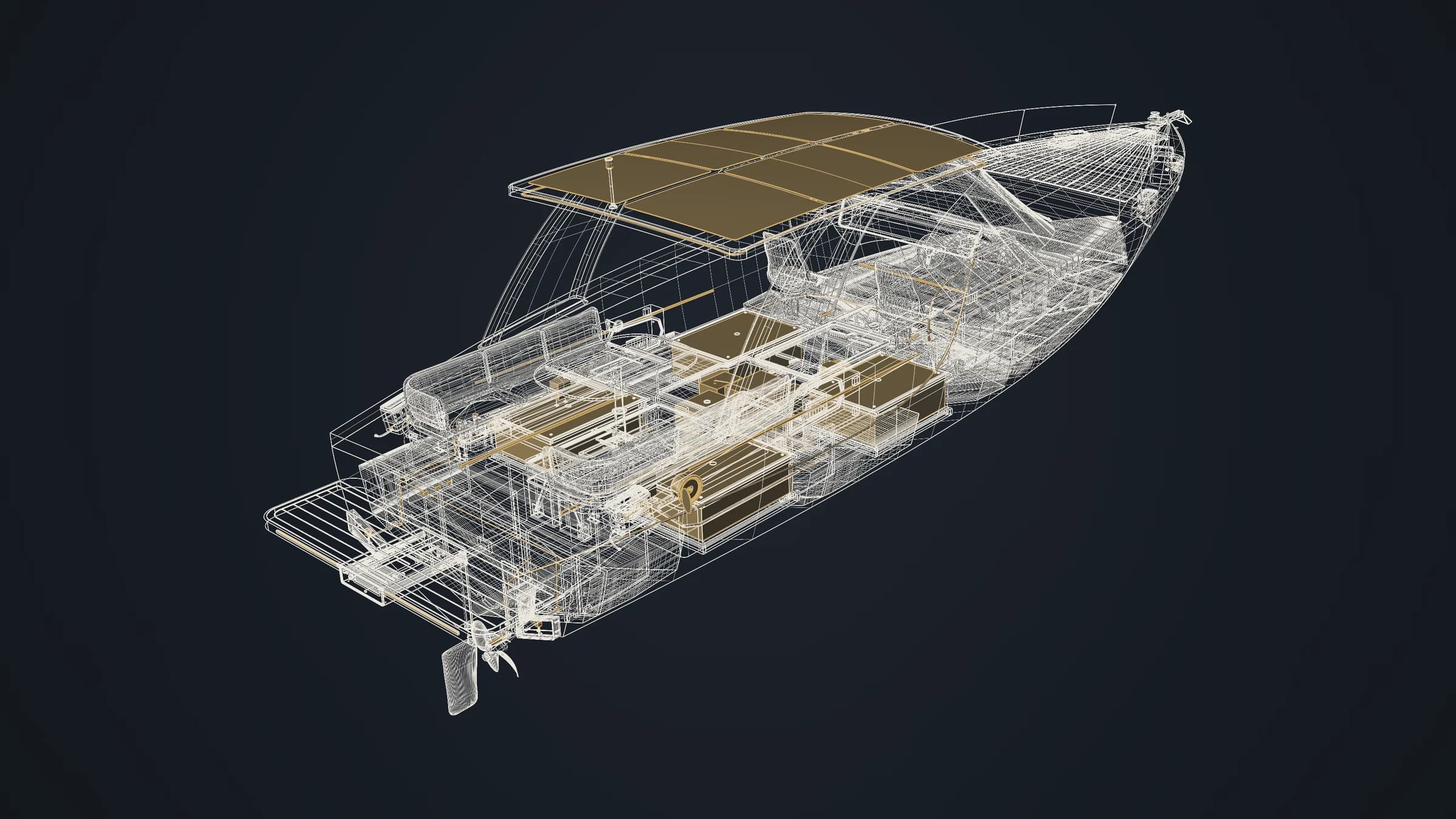
In an electric boat the most interesting part is the one you cannot see: the battery bank, the motor, the high-voltage routes and charging. Diagrams do not sell, and a concept has no interior photograph. So I took views from the master model with the shell as wireframe and the electrics in gold.
These are not renders but views captured straight from the model. They tell you where everything sits: solar panels on the roof, battery boxes under the aft seats at the service hatches, motor and reduction gear behind the batteries, a flush charge port in the topside and the routes on the centreline. The components are space reservations based on manufacturer data. Loads, protection and cable sizing have not been engineered.
This is the picture a salesperson opens when the customer asks where the batteries fit. The answer is visible in a second.
- Solar roof: six panels in the hardtop crown, following the roof's curvature.
- Batteries: boxes under the aft seats with service hatches straight above. Size and mass are still open.
- Motor: electric motor and reduction gear behind the batteries, shaft straight to the propeller.
- Charging: a flush port in the topside, the route runs under the deck to the battery space.
- Routes and lights: high-voltage routes as their own conduits on the centreline, navigation, work and interior lights in the same model.
Night renders and lighting are design, not decoration
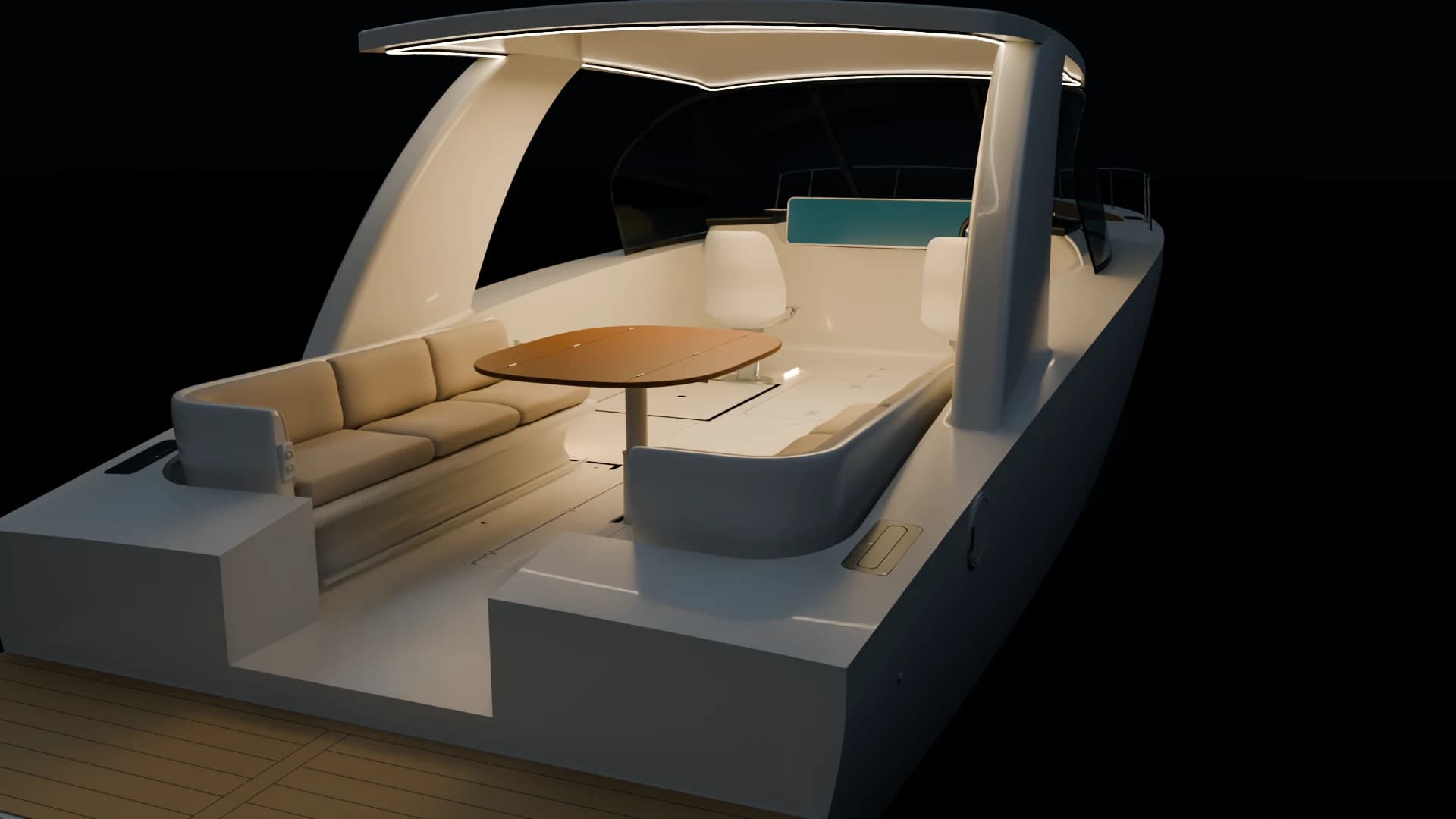
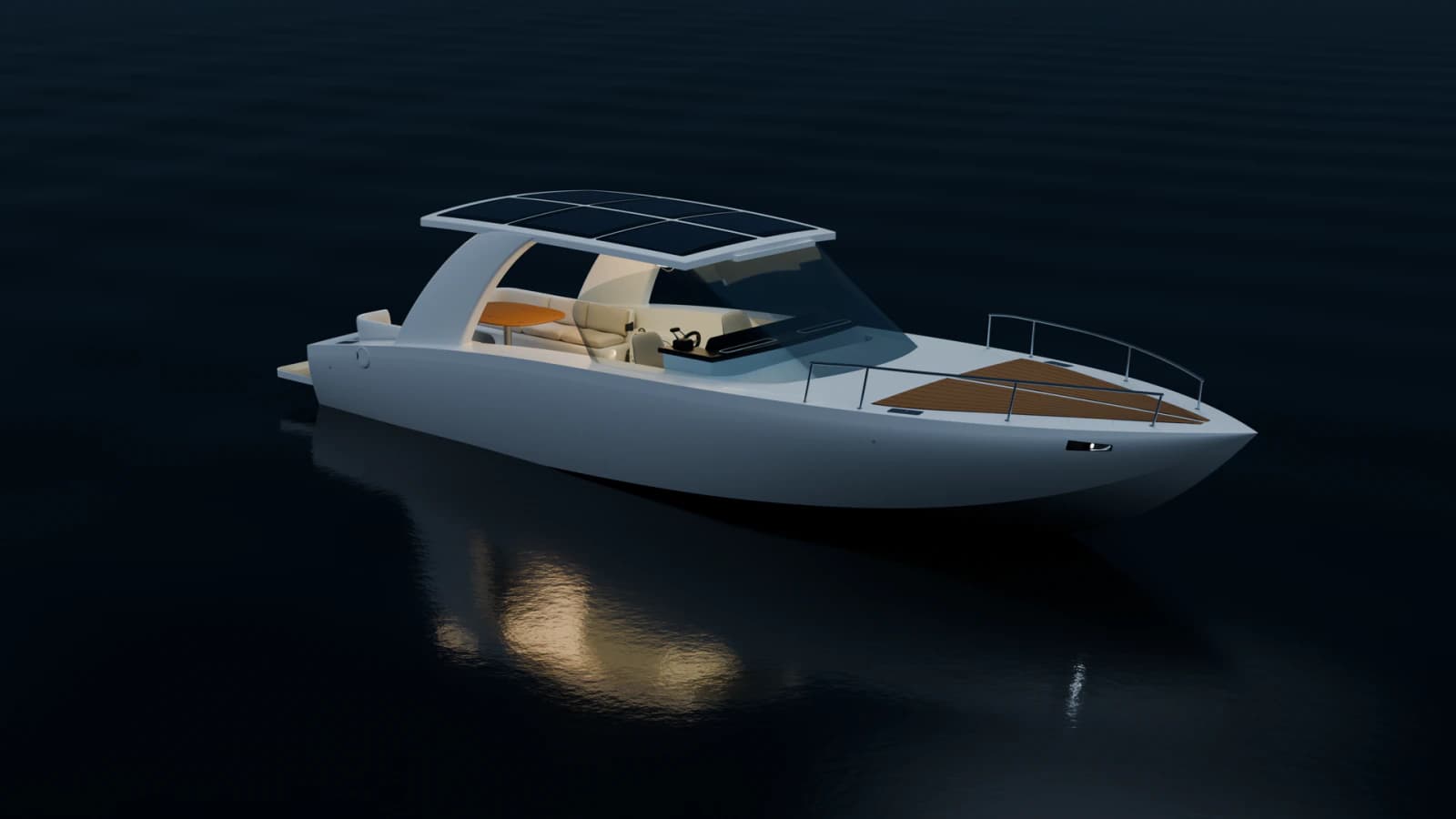
The boat was rendered at night on the water because a white boat in daylight looks like a box in a picture. At night the hull line is drawn by reflections, and the cockpit's own lighting turns the space into somewhere you want to be.
The cockpit lighting is part of the model. The roofline strip, the under-seat washes and the walkway markers are parts of their own, and the night image was rendered so that the boat's own lights carry the picture. The amount of light is visualisation, not a photometric measurement.
When the same boat is rendered again from a newer version, the lighting comes along without new design work. That is the second reason to keep the lights in the model rather than in image editing.
What a company can take from this for its own product
Few of my clients build boats. The same chain still works for a machine, a piece of furniture, a device or a building: one proper model that produces the renders, short function clips and, where needed, X-ray views of what sits under the shell.
The difference from photography shows in two situations. First: the product does not exist yet, but sales has to start. Second: the product exists, but its most important feature is inside and cannot be photographed.
The cost is weighted towards building the model. Once the model is right, a new angle, a colour version or a clip is light work. That is why I always ask first what else the model should deliver after the first picture.
An owner wondering how much is worth spending on this can think of it this way: if the product is sold before the customer sees it in person, the model does the job a demonstration unit would otherwise do.
The limits, said out loud
Honesty is not modesty. It means the buyer knows what a picture claims and what it does not. The same rule applies to a client's product: a render does not prove strength or dimensional accuracy, and that is worth saying next to the picture.
- An original fictional concept boat and digital design study. Not a boat sold for construction, and not a manufacturer's digital twin.
- No claims of seaworthiness, stability, classification, speed, range, structure or production readiness.
- The 11,800 × 3,550 mm dimensions are design targets, not measured boatbuilding dimensions.
- 20 kn / 30 nm is an accepted design target. No battery, motor power or top speed has been selected.
- Manufacturer images and data are private research sources only. They are not published and not used in marketing.
- Renders, clips and wireframes are an exterior-form preview, not dimensionally accurate CAD data.
Frequently asked questions
Is OMA118 Sport for sale?
No. It is my own concept work and practice project. The boat is not a product for sale, and its seaworthiness, stability and performance have not been demonstrated.
What software was the boat made with?
My own CAD and rendering pipeline, the same one I use in client work. The tools are not the point of this article. The method is: one master model, versions built on top of each other, checks before acceptance, and every picture from the same source.
Can a similar X-ray view be made of my own product?
Yes, if the product has, or gets, a 3D model where the internal parts are separate objects. Then the shell can be shown as wireframe or translucent and the chosen systems highlighted. It suits products whose most important feature sits under the shell.
Why are the clips so short?
Because they are watched on a phone. Five seconds is enough to show one function, and the viewer understands it without sound. A longer video needs editing and subtitles, and at that point you are in animation production.
How much does a package like this cost a company?
It depends on the model's level of detail and on how many pictures and clips are wanted from it. Building the model is most of the work; after that, extra pictures are light. Once I see the product I say directly whether to start with pictures, clips or something lighter.
What is still unfinished in this project?
Battery size and mass, structure, the real actuators for the table and the swim ladder, and stability and seaworthiness. None of it is promised. It gets done one version at a time, and this article is updated when there is something to show.